What Is Artificial Intelligence? A Beginner's Guide (2026)
Learn what Artificial Intelligence (AI) is, how it works, its types, benefits, real-world applications, and future in this simple beginner's guide.
Hasnain Shaikh
7/6/20264 min read
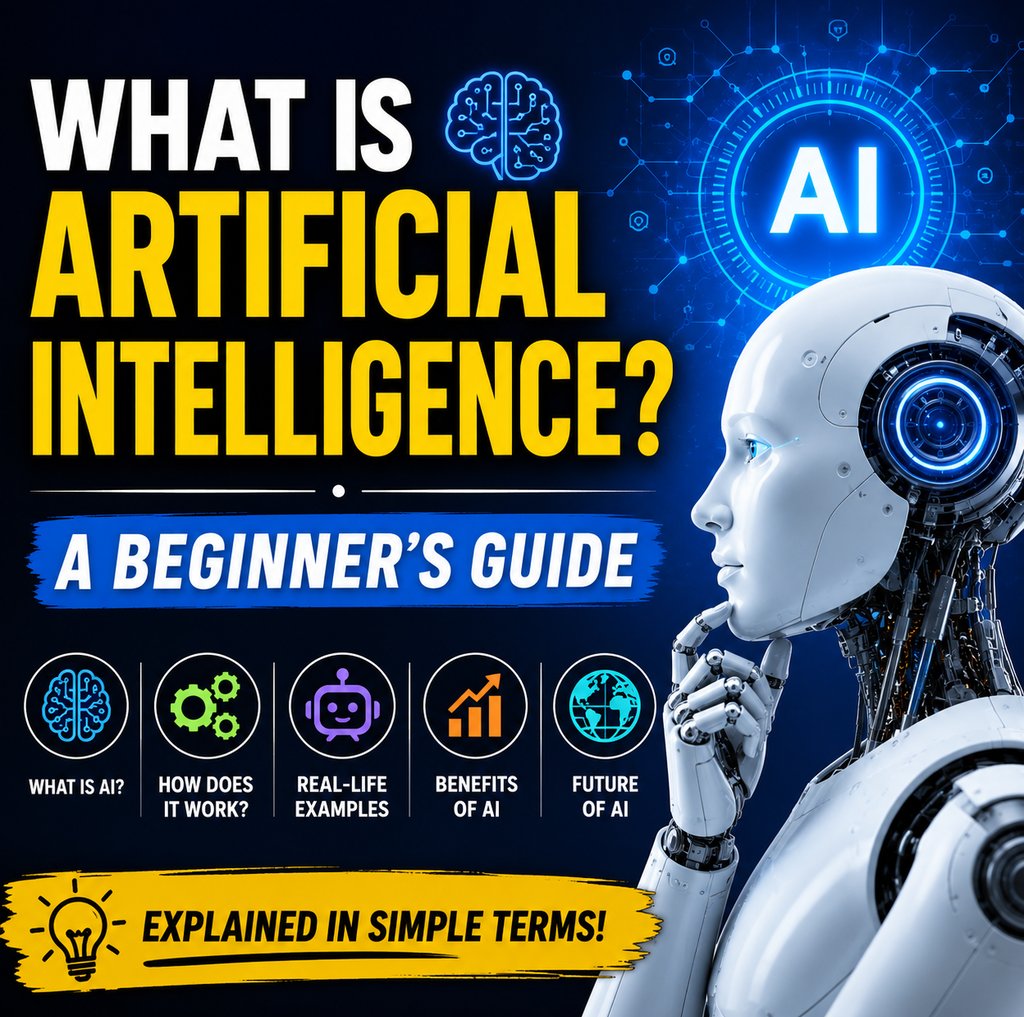
What Is Artificial Intelligence?
Artificial Intelligence (AI) is one of the most exciting technologies shaping our world today. From voice assistants like Siri and Google Assistant to self-driving cars and smart chatbots, AI has become a part of our everyday lives.
But what exactly is Artificial Intelligence?
Simply put, Artificial Intelligence (AI) is the ability of a computer or machine to perform tasks that normally require human intelligence. These tasks include learning, problem-solving, understanding language, recognizing images, making decisions, and even creating content.
Whether you're a student, professional, or simply curious about technology, this beginner's guide will help you understand AI in simple terms.
Table of Contents
What Is Artificial Intelligence?
How Does Artificial Intelligence Work?
Types of Artificial Intelligence
Examples of AI in Everyday Life
Benefits of Artificial Intelligence
Challenges of AI
AI vs Machine Learning vs Deep Learning
Future of Artificial Intelligence
How to Start Learning AI
Frequently Asked Questions
Final Thoughts
How Does Artificial Intelligence Work?
Artificial Intelligence works by collecting and analyzing large amounts of data. AI systems identify patterns in that data and use those patterns to make predictions or decisions.
A basic AI system usually follows these steps:
1. Collect Data
AI learns from data such as images, videos, text, numbers, or audio.
2. Process the Data
Algorithms analyze the information to find patterns.
3. Learn
Using techniques like Machine Learning, AI improves its performance over time without being explicitly programmed for every task.
4. Make Decisions
Once trained, AI can answer questions, recognize objects, recommend products, translate languages, and much more.
Types of Artificial Intelligence
There are four commonly discussed types of AI.
1. Reactive Machines
These AI systems only respond to current situations. They have no memory of previous experiences.
Example: IBM's Deep Blue chess computer.
2. Limited Memory AI
Most modern AI belongs to this category. It learns from historical data and improves over time.
Examples include:
Self-driving cars
Chatbots
Recommendation systems
Face recognition
3. Theory of Mind AI
This is still under development. Such AI would understand human emotions, beliefs, and intentions.
4. Self-Aware AI
This is a hypothetical form of AI where machines possess consciousness and self-awareness. It does not exist today.
Examples of Artificial Intelligence in Everyday Life
AI is everywhere, often without us realizing it.
Smartphones
Face Unlock
Voice assistants
Smart cameras
Streaming Platforms
Netflix and YouTube recommend videos based on your interests.
Online Shopping
Amazon and other e-commerce platforms recommend products using AI.
Navigation Apps
Google Maps predicts traffic and suggests faster routes.
Spam filters automatically detect unwanted emails.
Healthcare
AI helps doctors analyze medical images and identify diseases earlier.
Banking
Banks use AI to detect fraud and improve customer service.
Benefits of Artificial Intelligence
Artificial Intelligence offers numerous advantages.
1. Saves Time
AI automates repetitive tasks, allowing people to focus on more important work.
2. Reduces Human Errors
Properly trained AI systems can perform calculations and repetitive tasks with high accuracy.
3. Works 24/7
Unlike humans, AI systems don't need sleep or breaks.
4. Better Decision Making
AI analyzes huge amounts of data quickly, helping businesses make informed decisions.
5. Personalized Experiences
AI recommends movies, music, shopping products, and learning content based on user preferences.
6. Improves Healthcare
Doctors can use AI to detect diseases faster and provide more accurate diagnoses.
Challenges of Artificial Intelligence
Although AI offers many benefits, it also comes with challenges.
Job Automation
Some repetitive jobs may become automated, requiring workers to develop new skills.
Privacy Concerns
AI often relies on large datasets, raising questions about how personal information is collected and used.
Bias
If AI is trained on biased data, its decisions can also become biased.
Security Risks
Cybercriminals may misuse AI for sophisticated attacks and scams.
High Development Cost
Creating advanced AI systems requires significant computing power and expertise.
AI vs Machine Learning vs Deep Learning
Many people confuse these terms.
Artificial Intelligence Machine Learning Deep Learning Broad field of creating intelligent machinesA subset of AI where systems learn from dataA subset of Machine Learning using neural networksIncludes reasoning and decision-makingLearns patterns from dataExcels at image recognition, speech, and language processing
Think of it like this:
Artificial Intelligence = The entire field
Machine Learning = One way to achieve AI
Deep Learning = An advanced form of Machine Learning
Future of Artificial Intelligence
The future of AI looks incredibly promising.
Experts expect AI to transform industries such as:
Healthcare
Education
Agriculture
Finance
Transportation
Manufacturing
Entertainment
Customer Service
Generative AI is also enabling people to create text, images, videos, music, and software with remarkable speed, making advanced technology more accessible than ever.
As AI evolves, ethical development, transparency, and responsible use will become increasingly important.
How to Start Learning Artificial Intelligence
If you're a beginner, here's a simple roadmap:
Learn Basic Computer Skills
Understand how computers and software work.
Study Python
Python is the most popular programming language for AI.
Learn Mathematics
Focus on:
Statistics
Probability
Linear Algebra
Understand Machine Learning
Start with beginner-friendly concepts before moving to advanced topics.
Practice
Build simple AI projects like:
Chatbots
Image classifiers
Spam detectors
Recommendation systems
Frequently Asked Questions (FAQs)
Is Artificial Intelligence difficult to learn?
No. Beginners can start with free online courses and gradually build their knowledge.
Can AI replace humans?
AI can automate certain tasks, but human creativity, empathy, ethics, and complex decision-making remain essential.
Is coding required to learn AI?
Basic concepts can be learned without coding, but programming—especially Python—is helpful for building AI applications.
Where is AI used today?
AI is widely used in healthcare, banking, education, e-commerce, entertainment, transportation, customer service, cybersecurity, and many other industries.
What is the difference between AI and robotics?
AI refers to software that enables intelligent behavior, while robotics involves physical machines. Robots may or may not use AI.
Final Thoughts
Artificial Intelligence is no longer just a futuristic idea—it is transforming the way we live, work, learn, and communicate. From personalized recommendations to medical breakthroughs and smarter businesses, AI is driving innovation across nearly every industry.
For beginners, understanding AI doesn't require a technical background. Start with the basics, explore how AI is used in everyday life, and gradually build your skills through hands-on learning. As AI continues to evolve, having a foundational understanding of this technology will become an increasingly valuable skill in the digital age.
Whether you're a student, entrepreneur, or lifelong learner, now is the perfect time to begin your AI journey.
Connect
Stay in touch for fresh insights weekly.
Call
contact@growthverse.blog
+91 7738177635
Website designed by Shopper Space Enterprises